Paul St-Pierre-Plamondon Goes to Battle
On December 3rd, Paul St-Pierre-Plamondon harshly criticized artists' associations for their alleged subservience to the federal government. Since then, people have been calling it a political blunder, while the man himself seems to be doubling down to defend his remarks.
Let's examine his birth chart to get a better sense of who he is. I had already briefly discussed his personality in my post on the upcoming 2026 provincial elections.
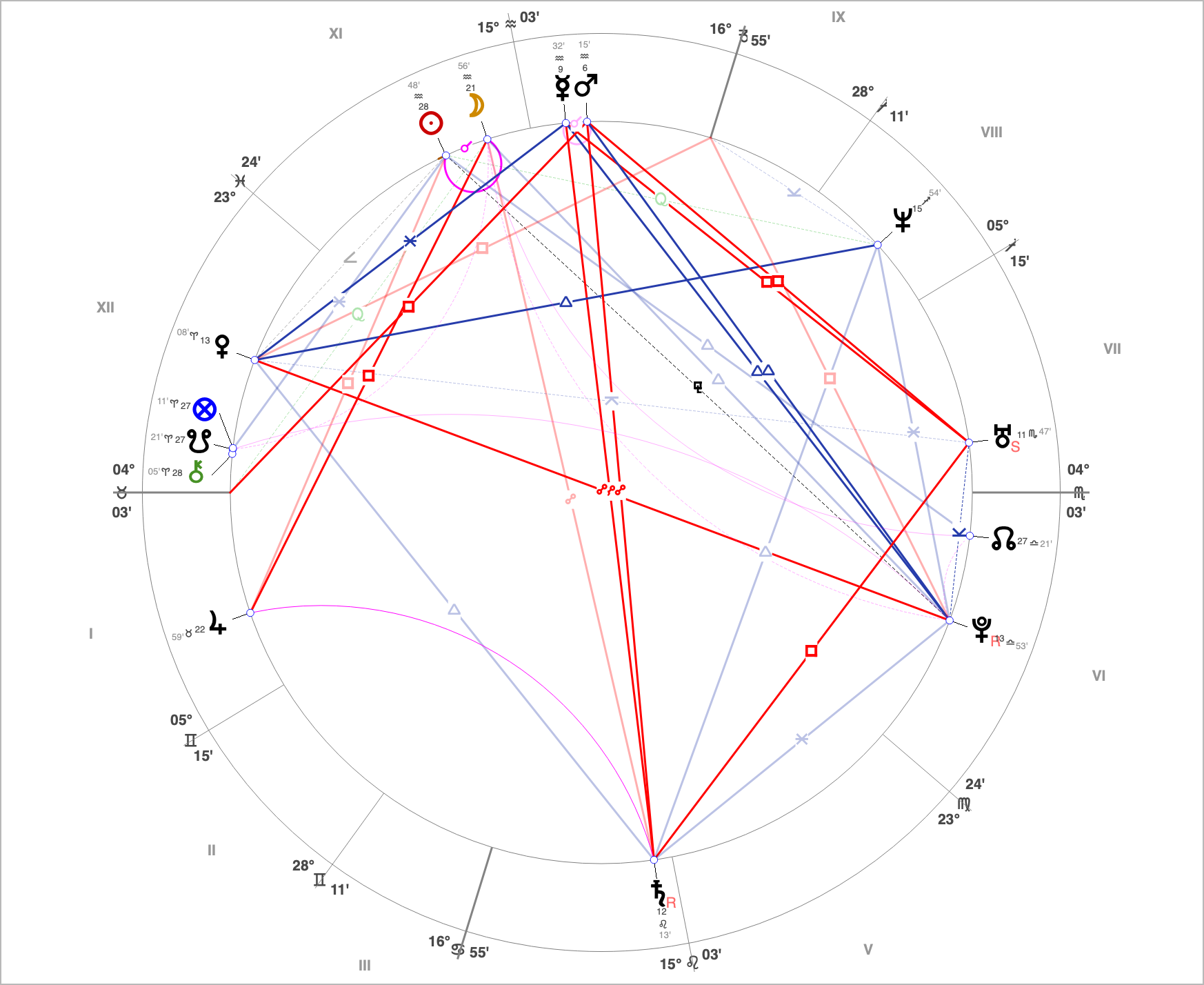
First, note the Mercury/Mars conjunction. It opposes Saturn and squares Uranus, making that planet the apex of a T-square in fixed signs. Given that PSPP is wholly and fully Aquarian (a fixed sign), this configuration presupposes an attitude of individual action in principle and relentless hard work. In harmonic terms, this translates into a preponderance of the number two (oppositions and squares).
A small nuance: in harmonic astrology according to the late David Hamblin, Mercury and Mars do not form a square with Uranus, but rather a 17th harmonic aspect (42°). This only adds to the tension, as the 17th harmonic presupposes a rebellious, subversive, and activist spirit.
Another important configuration is the Venus/Pluto opposition in semi-square/sesquiquadrate (trioctile) aspect to the Sun/Moon conjunction (PSPP was born under a new moon). Many angles derived from the 2nd harmonic and its multiples.

In his book Harmonic Astrology in Practice, David Hamblin described the 2nd harmonic (which he calls Twoness) as follows: a tendency toward differentiation, initiative, and goal-oriented action. Its symbol is the arrow—always in motion to transcend its own boundaries, connect the Self to the Other, move from A to B.
People marked by Twoness are characterized by ceaseless activity and constant effort to overcome obstacles, achieve goals, and accumulate accomplishments. There is always a tension, an internal conflict between different facets of the personality seeking reconciliation. This tension acts as a spur to action: the person is motivated to find concrete actions that will help resolve these inner conflicts.
We thus see a man quite effective at expressing change, but who may often place himself in a mode of "tension" toward others. The Venus/Pluto opposition could suggest a relationship dynamic of fusional love/hate with others.
This dualistic force has certainly enabled Paul St-Pierre-Plamondon to roll up his sleeves and move his party—once considered moribund—into first place in Quebec voter intentions.
The distribution of elements in PSPP's chart is: 3 points in Fire, 3 points in Earth, 7 points in Air, and only 1 point in Water. As for modalities: 3 points in Cardinal, 10 points in Fixed, 1 point in Mutable.
In short, Fixed Air = Aquarius, totally Aquarian. A Promethean figure with likely a combative and relentless spirit. "Deficiency" in Water and Mutability = Probably a difficulty with genuine empathy, with principles prevailing over emotionality and reconciliation.
It is with this perspective that we can observe the man's "outburst" in the current political context. This occurs at the very beginning of a long Uranus square Sun transit. People say PSPP is beginning to show his true colours, that—without endorsing his ideas—he is behaving like Pierre Poilievre.
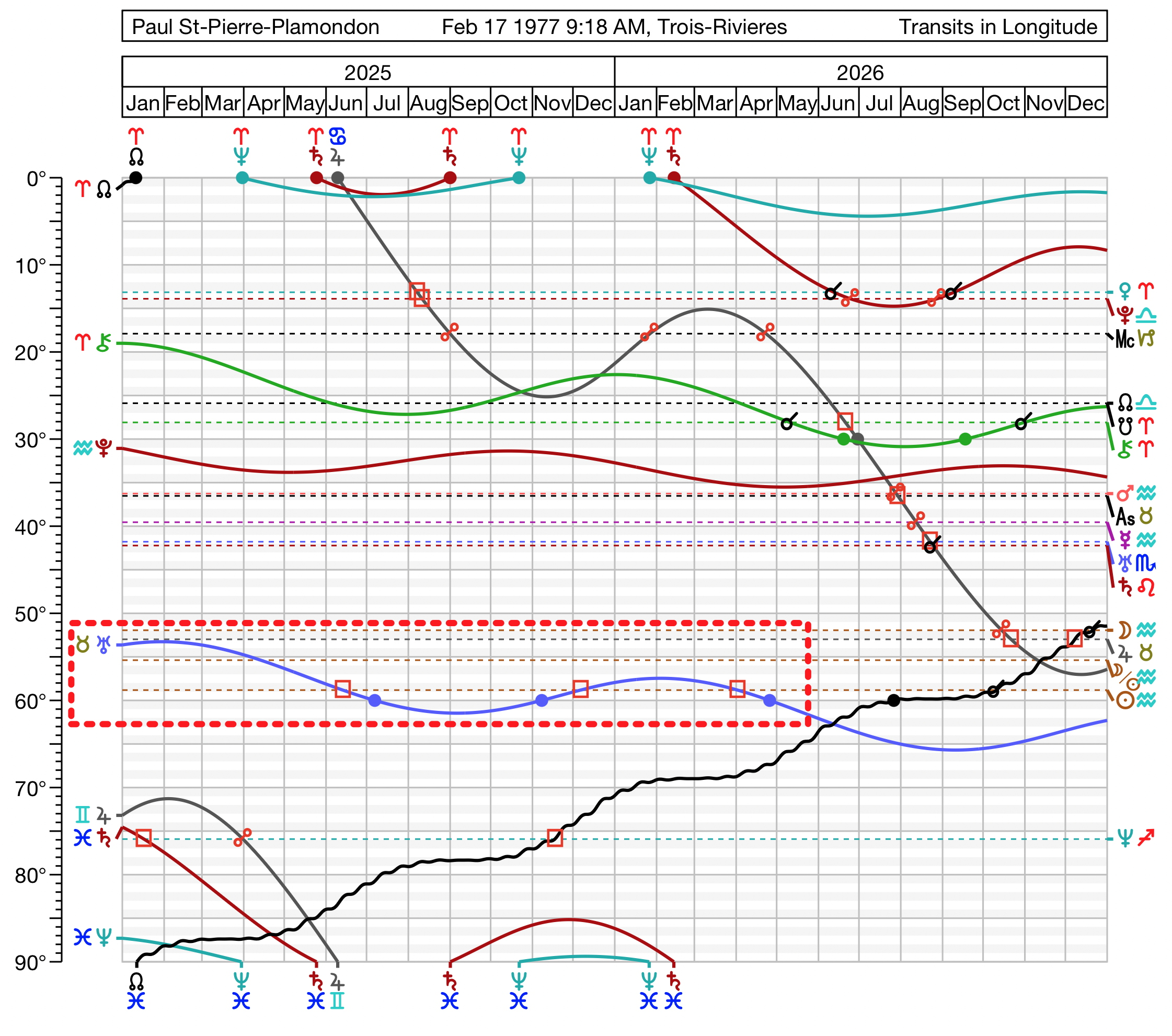
Uranus square Sun suggests awakening, or destabilization. Since he is perceived as a potential premier given his popularity in the polls, it seems risky to tap into radicalism—at least in expressing ideas that appear to diverge from the path he has taken thus far.
Perhaps it is merely a superficial coincidence and the man is simply being true to himself. Yet this Uranus seems to be strongly developing the traits inherent to Aquarius in the individual. The Sun is the last astrological point in Aquarius and therefore the last to receive this Uranus square.
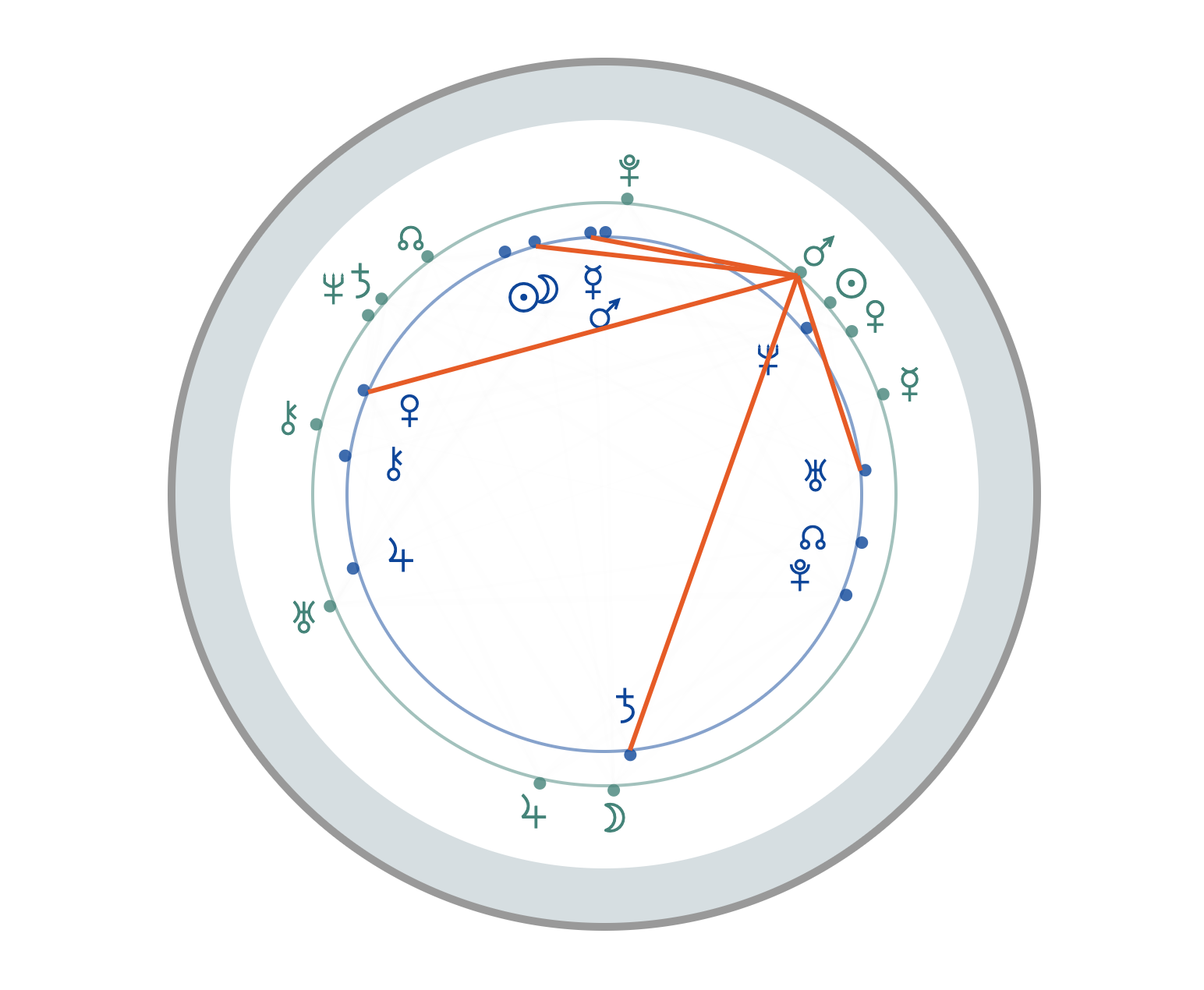
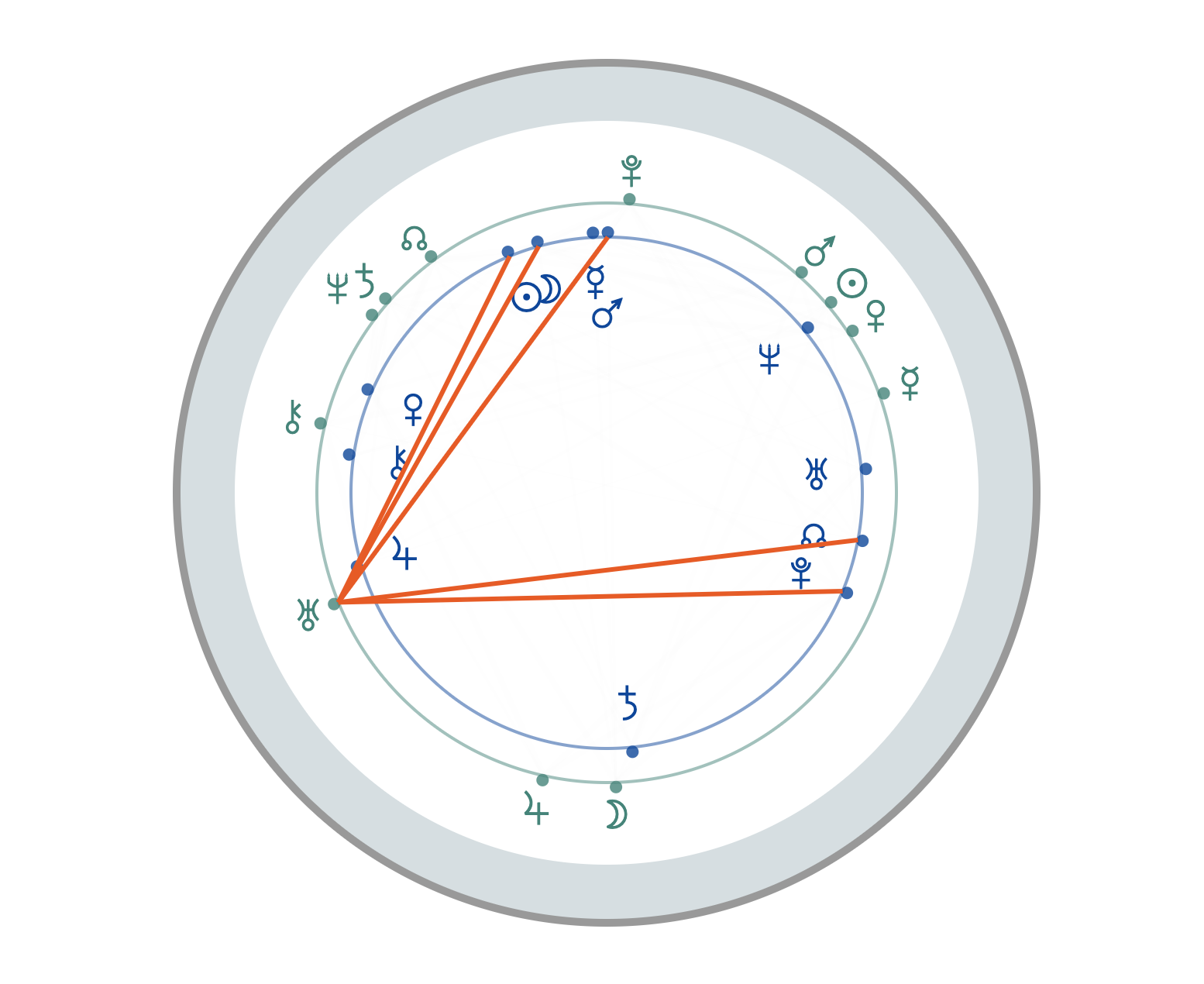
Uranus entered Taurus in 2018, thus squaring the sign of Aquarius. That was PSPP's first attempt to get elected as an MNA. The first planet to receive the square was Mars, in 2019—probably the awakening of what would become, in 2020, his election as leader of the Parti Québécois.
The next point is the Moon. Since we don't know PSPP's birth time, it's difficult to determine when this contact occurred. If we give him a Taurus Ascendant, the Moon would be around 20° Taurus, right when popular favour placed him first in voter intentions! (The Moon is considered to represent the people in mundane astrology.)
2026 will still be marked by the Uranus square Sun, which portends more months of radicalization and instability. In positive terms, it is a struggle toward liberation. In more difficult terms, it is a battle to claim one's place.
We should then watch for Saturn's passage over the Venus/Pluto opposition. This is not, at first glance, an easy transit.
It is a particularly intense transit because Saturn activates the entire natal Venus-Pluto opposition, which is already a charged configuration in itself. Here's what an astrologer might say about it:
The natal Venus-Pluto opposition already suggests an emotional life marked by intensity, power dynamics in relationships, a capacity for deep attachment but also patterns of control, possessiveness, or radical transformations in love. Questions of personal values and self-esteem are often tied to deep, sometimes painful emotional experiences.
When Saturn transits this opposition, it acts as a revealer and crystallizer.
On the relational level—a period of serious assessment: a relationship may be put to the test, confronted with its limits or shadow zones. What is not solid may collapse. A separation or distancing is possible if the relationship was built on fragile foundations or unhealthy dynamics. Conversely, a more mature and realistic commitment may solidify.
On the level of values and self-esteem—Saturn demands structural work. Old Plutonian wounds (rejection, betrayal, abandonment) may resurface to finally be faced and integrated. It is often a time of emotional sobriety, sometimes austere, but potentially liberating.
On the financial level (Venus also being linked to resources)—possible restrictions, restructuring, or the need to clarify issues of shared money or material dependency.
In sum, it is a transit of emotional maturation and confrontation with the truth of one's bonds. Demanding, but potentially very constructive for those who accept doing this deep work.
Note also that at the time of the election (if it takes place as scheduled on October 5, 2026), the Sun will be conjunct Pluto, opposite Venus, and therefore opposite transiting Saturn! Mercury will also transit Uranus, as will Venus. Meanwhile, Mars will be nearly opposite natal Mars.
The date will be truly significant for him! If he comes to power, it will be in a very intense and difficult context, in my opinion.
But let's go further. Slow-moving Pluto is also active in Paul St-Pierre-Plamondon's chart. It will make a first contact within orb of Mars as early as May 2026, returning in force (after an apparent retrograde) throughout spring and summer 2027. But if we consider Mercury's proximity at 9° Aquarius, the entire 2026–2030 period is affected by Pluto's passage.
If the politician is brought to power in 2026, this augurs an intense time for him, but certainly also for the people who will have elected him. A referendum with turbulent undertones ahead?