The Patrick Bruel Case
On March 18, 2026, Mediapart published what has since become known as The Patrick Bruel Case. The publication introduces its special report as follows:
Since Mediapart’s first revelations in March 2026, the celebrated singer has been accused of sexual and gender-based violence by nearly thirty women. Several allege rape. The artist, who is the subject of three judicial investigations, disputes any "coercion" or "violence" and is entitled to the presumption of innocence.
Unfortunately, I am unable to consult the contents of this dossier, as it is behind a paywall. I am not convinced that it would reveal much beyond what an artificial intelligence can already gather from publicly available sources, or what is summarized in the corresponding Wikipedia article. Ultimately, we will have to wait for the outcome of one or more trials, should they take place.
Attempting to reconstruct such a case through astrology is an inherently risky and highly speculative exercise. It also runs the danger of undermining the presumption of innocence to which every accused person is entitled. Nevertheless, I believe it is worthwhile to take an astrological look—not in order to establish guilt or innocence, but simply to examine whether the symbolism is consistent with what is publicly known.
As for the allegations themselves, they are undeniably serious, and one can only hope that the French judicial system will conduct its work thoroughly and fairly.
Before reaching that point, however, let us first examine the natal chart of the artist, whose birth data are known accurately. What can be inferred about Patrick Bruel’s personality?
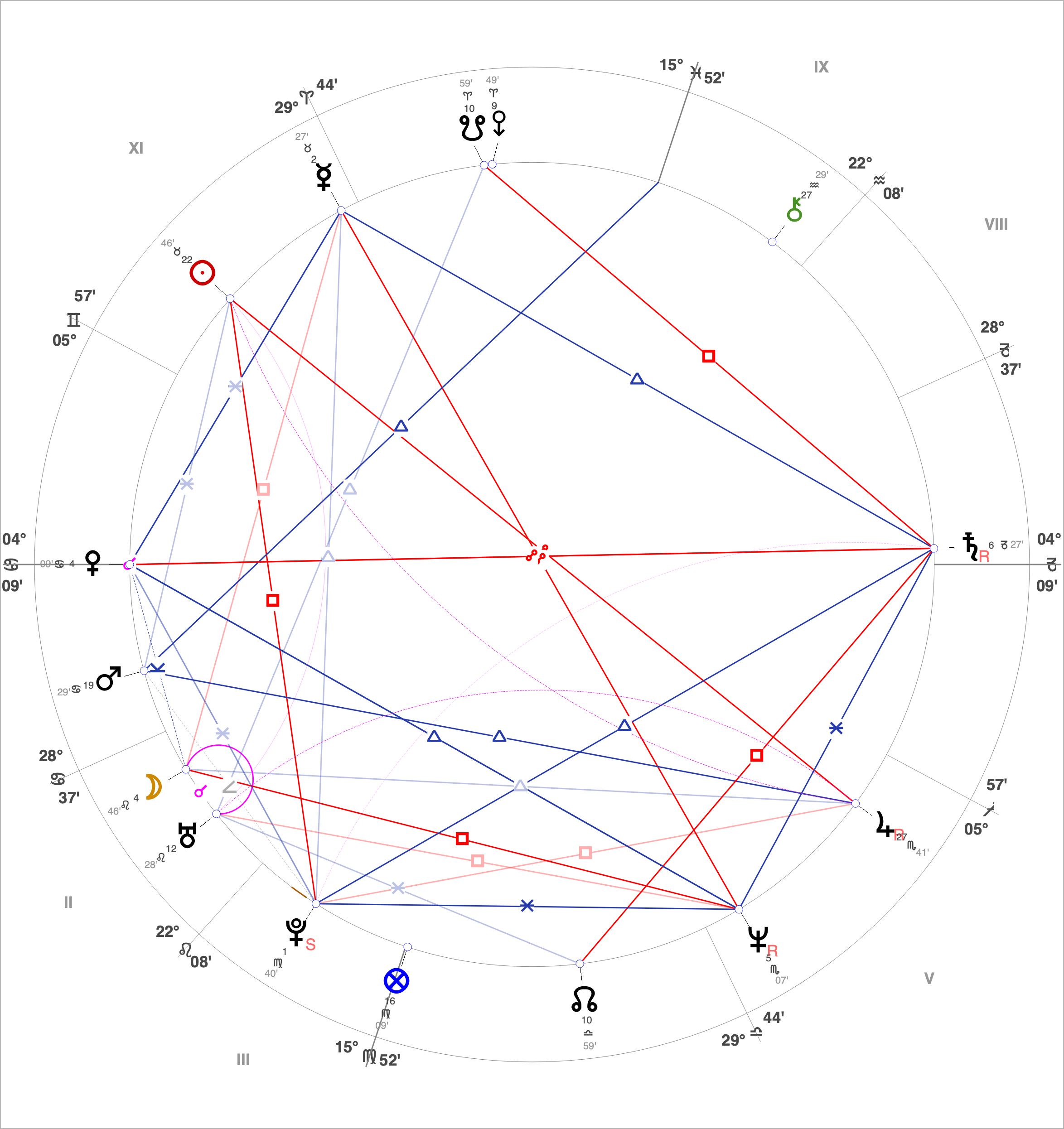
The basic measurements are as follows:
Elements
- Fire 3
- Earth 5
- Air 0
- Water 6
Modalities
- Cardinal 4
- Fixed 8
- Mutable 2
House Types
- Angular 2
- Succedent 8
- Cadent 2
Dominated by Earth and the Fixed modality, with a complete absence of Air, this chart suggests an essentially physical temperament. It also benefits from a highly integrated planetary structure in which every planet is connected to the others. One might infer that Bruel possesses considerable resources and a strong capacity to face life’s challenges. The fact that most planets occupy succedent houses is also noteworthy: it suggests that the major turning points of life regularly emerge only after long periods of maturation. Events appear less "manufactured" by immediate willpower and more gradually revealed over time.
Two T-squares deserve particular attention: Pluto = Sun/Jupiter and Moon/Uranus = Mercury/Neptune. These represent powerful internal tensions pursuing resolution. Equally important is the Venus-Saturn opposition. In addition, both Venus and Mars are out of bounds (OOB), meaning they lie beyond the Sun’s normal declination limits. Symbolically, these planets operate outside the usual solar framework, as though they were partially beyond the individual’s conscious regulation.
With hindsight, an astrologer might be tempted to interpret such symbolism as indicative of sexually deviant behaviour. This illustrates one of astrology’s recurring pitfalls. Symbols are inherently multivalent, and with enough imagination they can be made to support almost any narrative.
I hope that more precise dates will eventually become available. They constitute the ultimate test for understanding, through planetary dynamics, the impulses and tendencies that may underlie particular actions. We should remember, however, that Patrick Bruel is hardly the only person born on May 14, 1959, around nine o’clock in the morning. I am the same age as he is, born only two months earlier. Consequently, I share broadly similar positions of the outer planets—Jupiter, Saturn, Uranus, Neptune, and yes, Pluto (astrologers continue to insist on Pluto’s importance).
It would be a fascinating opportunity to compare the lives of true astrological "twins", people reading these lines who possess essentially the same natal configuration.
In any event, a birth chart does not determine an individual. It merely colours the personality. What each person ultimately makes of that potential depends on countless factors, including personal choices, upbringing, circumstances, and the river that carries them.
Returning to Bruel, the Venus-Saturn opposition deserves careful study because it lies precisely across the horizon, the axis of relationship (Venus in the First House, representing the self, and Saturn in the Seventh, representing others). This opposition often reflects considerable reserve in the expression of affection. Such individuals do not readily reveal their emotions and may require many years before fully trusting another person. Beneath this caution often lies a profound fear of rejection, abandonment, or of not being worthy of love. Added to this is a Sun placed in the Eleventh House, emphasizing friendship and social belonging, while simultaneously locked in a difficult square with Pluto.
The Venus-Saturn opposition ultimately invites the transformation of a fear of being unloved into the capacity to love with maturity. Its challenge is to discover that genuine emotional security arises not through control or self-sacrifice, but through self-esteem strong enough to sustain relationships in which affection can flow freely without needing constant proof.
When Venus-Saturn is considered alongside the Mercury-Neptune opposition, another important theme emerges. Questions of relationship, perception, and representation become intimately intertwined. This cannot explain specific behaviours or establish factual conclusions, but it does suggest a possible psychological climate.
Venus-Saturn describes tension between the desire for intimacy and a tendency toward restraint, control, or emotional insecurity. Relationships may be experienced as demanding, accompanied by difficulty reconciling the longing for love with the fear of vulnerability.
Mercury-Neptune, on the other hand, makes perception more permeable. This opposition may produce extraordinary imagination, profound intuition, and artistic or poetic gifts, but it may also blur the boundaries between reality, idealization, and rationalization. Communication itself can become ambiguous, intentionally or otherwise, and individuals may occasionally come to believe their own interpretation of events.
Together, these two oppositions may create a psychological dynamic in which the emotional struggles of Venus-Saturn are filtered through Mercury-Neptune. Emotional pain may be transformed, sublimated, reinterpreted, or idealized by the workings of the mind. In an artistic context, this combination is often remarkably productive, fostering exceptional sensitivity and the capacity to create characters or songs that resonate deeply with audiences.
From a psychological perspective, one could also suggest that the individual may experience difficulty viewing personal motivations and relationships with complete objectivity. Mercury-Neptune tends to dissolve boundaries, whereas Venus-Saturn tends to harden defensive structures. Their coexistence can therefore produce an alternation between control and ambiguity, between severe lucidity and idealization.
In Bruel’s case, this configuration appears to have contributed greatly to his talent and creative energy, while also suggesting relational complexity and an intense, perhaps frustrated, longing to be loved.
The Revelations of March 2026
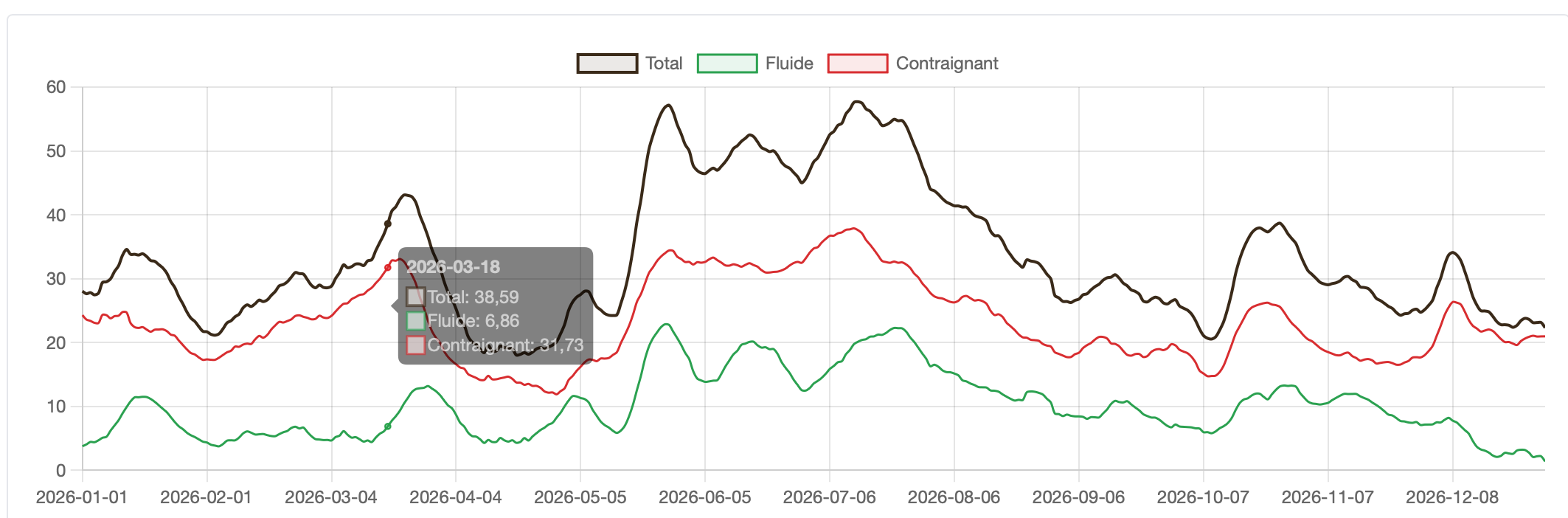
The publication of the Mediapart investigation on March 18, 2026, sent a profound shockwave through the public. Astrologically, this coincides with the activation of the Pluto T-square through Pluto’s opposition to the natal Moon. Jupiter simultaneously forms a semi-square to Pluto, another challenging configuration in the natal chart. Although transiting Saturn may be trine the Moon, this supportive influence seems comparatively minor compared with Saturn’s far more difficult role as the apex of the Venus-Saturn axis, creating a double-square midpoint configuration. Finally, Uranus opposes natal Jupiter after having crossed the natal Sun during 2024–2025.
One could scarcely imagine a more powerful series of planetary activations. It resembles a nuclear barrage striking Bruel’s natal chart.
Presented with this date alone, many astrologers would likely nod in recognition and feel tempted—without any judicial process—to pronounce their own verdict. The symbolism appears strikingly consistent.
Following the publication of the article, an avalanche of accusations emerged concerning alleged acts that, in some cases, had previously attracted police attention but resulted in no formal charges.
In total, roughly thirty women have come forward. As mentioned earlier, however, very few precise dates are publicly available. One reported period is November 1997, when Venus and Mars were transiting near natal Saturn while Uranus opposed the natal Moon. Another is October 12, 2012, during Pluto’s prolonged conjunction to the same natal Saturn while Uranus simultaneously squared it, once again acting as apex to the Venus-Saturn axis.
For the moment, this evidence remains limited. Yet given the magnitude of the affair, additional chronological details will almost certainly emerge over time.
I repeat what deserves repeating: let the justice system follow its course. If more reliable dates eventually become public, astrology may gain valuable material with which to continue its research in this area.
Bruel'd data are found under this link: https://orbiscantus.com/en/chart/bd1783195928